
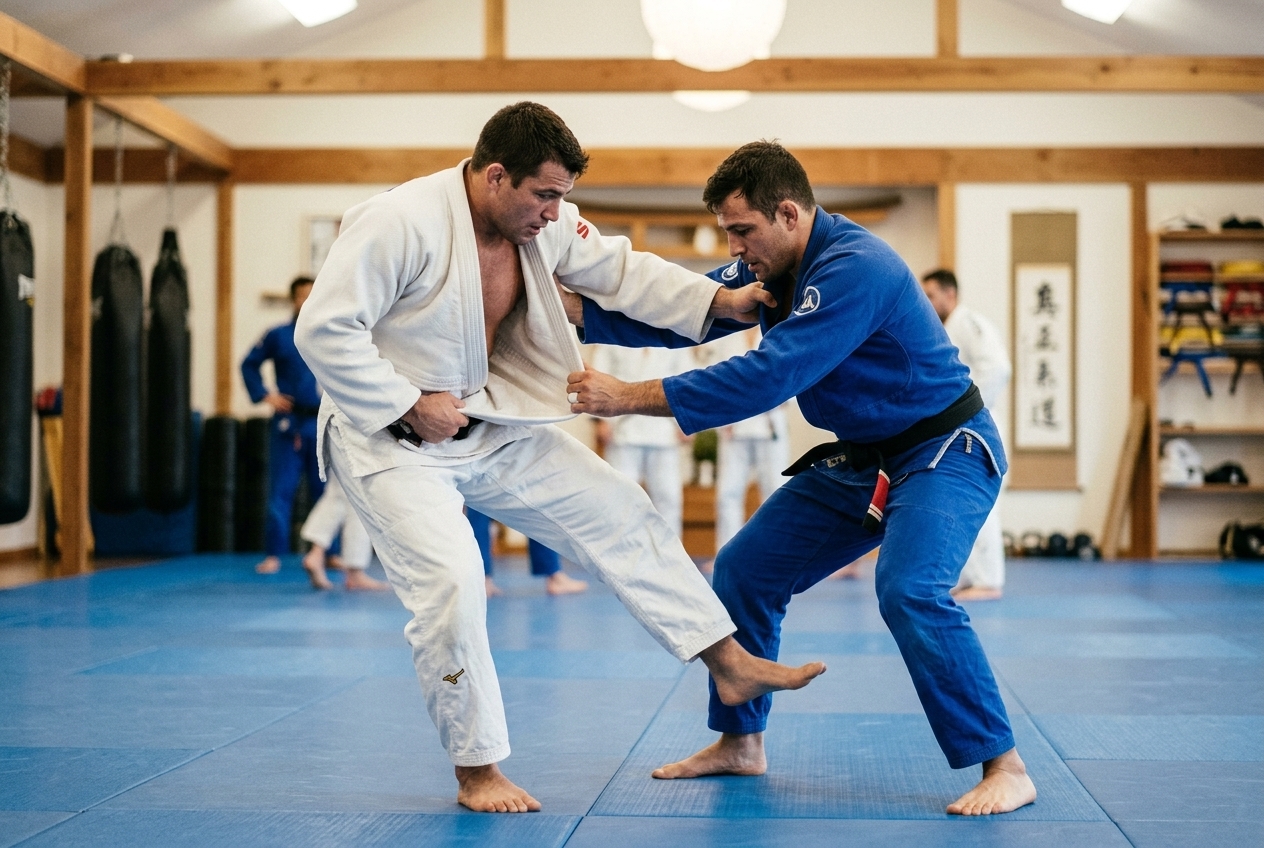
Difference Between Judo and BJJ
At first glance, Judo and Brazilian Jiu-Jitsu (BJJ) look remarkably similar. Both are grappling arts practiced in a gi, both trace their roots directly back to Japanese Jiu-Jitsu, and both share many of the exact same throws and joint locks.
However, while they share the same DNA, a single core philosophy separates them: Judo aims to finish the fight on the feet, while BJJ aims to control and finish the fight on the ground.
1. Primary Focus and Objective
-
Judo (The Art of Throws):
In Judo, the ultimate goal is the Ippon—throwing your opponent onto their back with force, speed, and control to end the match instantly. Ground combat (Ne-waza) exists, but referees restart the action quickly if a submission or pin isn’t established right away.
-
Brazilian Jiu-Jitsu (The Art of Ground Control):
In BJJ, a throw or takedown is merely the entry point. The primary objective is to take the fight to the mat, secure a dominant position (like the mount or back control), and force a submission via chokes or joint locks.
2. Ruleset and Combat Rhythm
-
Rules Shape the Style: Judo rules reward explosive power, balance, and high-amplitude throws. Because time on the ground is limited, Judokas develop lightning-fast transitions into pins or armbars.
-
Patience and Positional Strategy: BJJ rules encourage positional hierarchy and strategic leverage. Practitioners are allowed extended time on the mat to set up traps, sweep from the guard, and methodically dismantle their opponent’s defense.
3. Equipment: The Gi Dynamics
While both martial arts use a traditional heavy jacket and pants (judogi or BJJ gi), the way grips are used differs significantly:
-
Judo grips focus on controlling the collar and sleeve to break posture and initiate powerful off-balancing (Kuzushi).
-
BJJ grips extend beyond throws, utilizing lapels and sleeves to control limbs, create guards (like De La Riva or Worm Guard), and wrap up submissions on the mat.
The Verdict: Two Sides of the Same Coin
Rather than viewing Judo and BJJ as competing systems, top martial artists treat them as complementary disciplines.
A Judoka who develops strong ground control becomes an unstoppable force, just as a BJJ practitioner with elite Judo takedowns commands immediate respect the moment a match begins. Mastering both provides the ultimate framework for complete grappling excellence.